

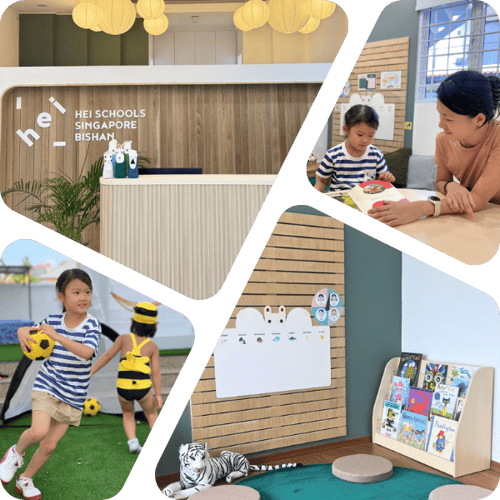
For many children with developmental needs, the choice is often limited to either mainstream classrooms that may not provide enough support, or specialised settings that may not offer a typical school experience. Singaporean inclusion pioneer Jayne Nadarajoo and HEI Schools CEO Inkeri Aimonen set out to change that.
A new way of thinking inclusive preschool has been implemented at HEI Schools Singapore Bishan. The model is built around one preschool that offers two structured, yet complementary, learning programmes: HEI and HEI Bridges. Children are enrolled in the programme that best supports their current developmental needs, learning in dedicated classroom. This approach allows children to receive the support they need without being excluded from a social school environment.
From experience to a new model
Jayne Nadarajoo: Building Inclusive Education from Experience
 With over 30 years of experience in early childhood, international and special education, Jayne Nadarajoo has consistently built schools that challenge traditional boundaries in education.
Her journey began with a simple but powerful belief: that children learn best in environments that are nurturing, inclusive and responsive to their individual needs. As both an educator and a parent, she saw firsthand the limitations of one-size-fits-all systems.
Over the years, through founding preschool chains such as White Lodge Preschools and Avondale Grammar School, and special education schools such as Melbourne International School and The GUILD International College, Jayne worked closely with children across a wide range of developmental profiles.
This experience revealed a persistent gap:
- Early childhood education, therapy, and specialised support are often fragmented
- Families are left to navigate multiple systems
- Children who did not fit neatly into mainstream are underserved
Even in well-established schools, inclusion often depended on individual teachers rather than a consistent, structured approach.
When Jayne encountered the HEI Schools model, she recognised its strength in delivering high-quality, holistic education. But she also saw the opportunity to go further — to build a model that transforms the way inclusion is thought about.

Jayne Nadarajoo
The pioneering operator behind HEI Schools Singapore Bishan and the founder of White Lodge Preschools, Avondale Grammar School, Melbourne International School and the Guild.
“For many families, the challenge is finding the right kind of environment where their child can truly belong, be supported, and grow,” says Jayne Nadarajoo.
Inkeri Aimonen: A Personal Mission for Inclusive Education
.png?width=200&height=300&name=Inkeri%20Aimonen%20A%20Personal%20Mission%20for%20Inclusive%20Education%20(1).png) For Inkeri Aimonen, CEO of HEI Schools, the commitment to inclusive education is also deeply personal.
For Inkeri Aimonen, CEO of HEI Schools, the commitment to inclusive education is also deeply personal.
As a parent of a neurodivergent child, Inkeri has experienced firsthand the challenges of navigating early education systems across different countries — including both the United States and Finland.
Through HEI Schools’ global work in delivering holistic, child-centred education, she recognised an important limitation: while the Finnish approach supports many learners well, some children require additional, structured developmental support that most preschools are not equipped to provide.

Inkeri Aimonen
HEI Schools' CEO
“These experiences led me to want to develop a preschool model that offers personalised learning pathways and supports both the child and the family holistically.”
One school, two structured pathways, with flexibility
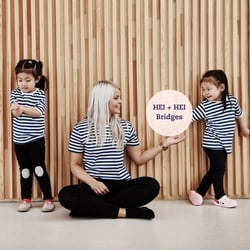 The model brings together two structured, complementary programmes within one preschool: HEI and HEI Bridges. Children are enrolled in the programme that best supports their current developmental needs, learning in dedicated classroom settings with specialised support where needed.
At the same time, the model is designed to be flexible. As children develop, they can transition between HEI Bridges and the HEI Programme when appropriate. This creates a structured but adaptable learning pathway within one school.
A key benefit of this model is that it provides a “preschool experience” for children who might otherwise not have access to one. Many children with developmental needs are often limited to therapy-based support, home-based learning or specialised settings without a typical preschool environment with friends.
HEI Schools Singapore Bishan addresses this gap by offering these children access to a structured, social and engaging preschool experience — while still providing the level of support they need.
HEI provides the mainstream early childhood education environment, while HEI Bridges provides a more structured, supportive setting for children who require additional developmental support.
Rather than separating these pathways across different institutions, both programmes exist within the same preschool. This allows children to remain within one school community, without needing to transition between different institutions.
Impact: Families, Educators, Society
For Families: A More Supported Journey
 Families benefit from a more coordinated support system, where education and developmental support are provided in one place. This reduces the need to manage multiple providers and creates a more consistent experience for both the child and the family.
For Educators: Stronger Practice Through Training and Collaboration
 Educators work in interdisciplinary teams alongside specialists, enabling them to better support children with communication challenges, behavioural needs and different learning profiles within the same classroom.
For Children: Stronger Foundations for Communication, Independence and Participation
 Children benefit from:
- access to a structured preschool environment suited to their needs
- peer interaction within a consistent school setting
- flexibility to move between levels of support as they develop
- development of confidence, communication and independence
For Society: Inclusion in Action
 Inclusive early education helps shape a more inclusive society.
When children grow up learning together across differences:
- empathy becomes natural
- diversity is normalised
- communities become stronger